“How think can you actually go?”
It’s probably the most common question we get on the phone, and the honest answer is that it depends entirely on the method. A hand saw and a diamond wire saw are both sawing concrete, but they’re not remotely in the same league when it comes to depth.
Get the method right and the job’s straightforward. Get it wrong, and you’re either paying for gear that’s overkill, or you’re halfway through a slab with a saw that was never going to reach.
Here’s how the depths stack up, method by method, and what actually decides which one your job needs.
Depth By Method
Hand sawing: up to 150mm
Hydraulic, high-frequency, and electric hand saws. This is the go-to for most residential and light commercial work, and it covers the majority of driveways, paths, patios and standard slabs.
It’s quick to set up, easy to move around a site, and it gets into spots a bigger machine can’t. If your job is a typical home slab, this is very likely all you need.
Ring sawing: up to 270mm
A ring saw uses a blade driven from the outside edge rather than the centre, which is what lets it get deeper than a hand saw of the same size.
The other advantage is plunge depth close to a wall or a corner, so it’s useful for openings and cut-outs where a standard saw would leave you with an overcut you then have to finish by hand.
Track-mounted wall sawing: up to 500mm
The saw runs on a track bolted to the wall, so the blade follows a dead straight line under power. Doorways, window openings, lift shafts, stairwells and service penetrations.
Because the track carries the weight, it works vertically, on an angle, or overhead. This is where most “can you put a door through that wall?” jobs land.
Floor and road sawing
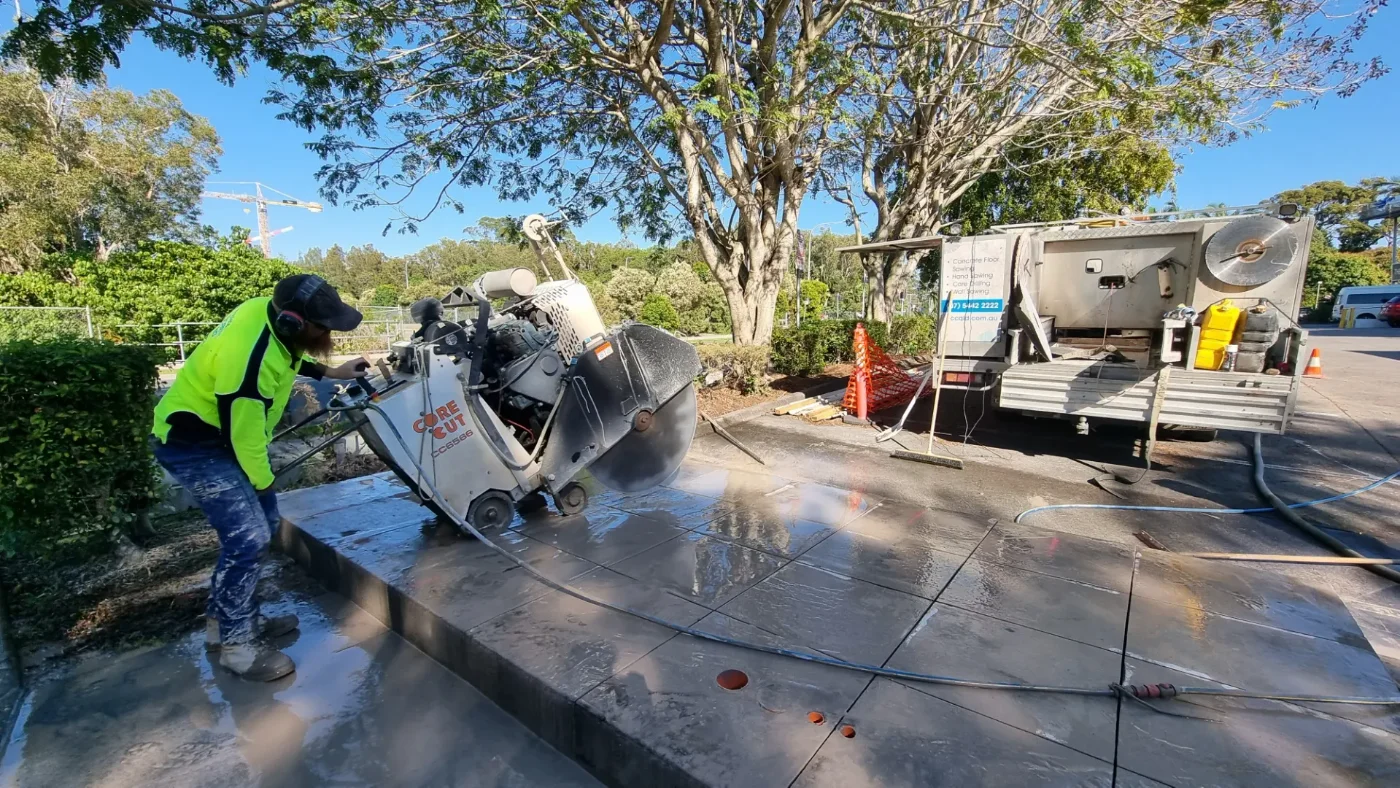
A walk-behind machine for horizontal work: roads, car parks, footpaths, driveways, expansion joints and large slab removals.
Depth here comes down to the machine and the blade fitted to it, and a road saw will reach considerably deeper than a hand saw. For long straight runs across a big area, nothing else is as fast.
Diamond core drilling: 12mm to 700mm diameter
Different measurement, but worth including because people often ask about it. Core drilling is about hole diameter rather than depth, and we can go from 12mm up to 700mm, at any angle, above or below ground.
Depth is handled by adding barrel extensions, so a deep core is a matter of setup rather than a hard limit.
Diamond wire sawing: no practical depth limit
And then there’s the wire. Instead of a blade, a steel cable threaded with industrial diamond beads runs in a continuous loop through the material, pulled by a hydraulic drive unit set back from the work.
Because the loop can be made as long as the job needs, thickness stops being the deciding factor. Concrete wire cutting is what gets used on bridge structures, thick footings, sea walls, piers, oversized machine bases, and anything else where a blade simply can’t reach.

Why Diamond Wire Sawing Doesn’t Have a Depth Limit
It’s worth understanding why, because it changes how you think about a job.
With a blade, the machine has to be at the work, and the blade has to be bigger than the thing you’re sawing through. Both of those become a problem fast on thick or awkward material.
With a wire, the drive unit sits back from the cut and only the wire goes through the material. Add more wire, and you can go further. That single difference is what unlocks the rest of it.
What that means on site:
- Reinforcing steel isn’t an obstacle. Heavy rebar, mesh and post-tensioned slabs all go the same way as the concrete.
- It works around obstructions. Where access is tight, at height, or underwater, the saw doesn’t need to be right at the face.
- Very little vibration. There’s no hammering and no shock loading, so what’s staying put isn’t disturbed. That matters on live sites, occupied buildings and anything structurally sensitive.
- Sections come out whole. Where the job suits it, a piece can be freed for a crane to lift out in one, which usually means less mess and less patching afterwards.
- It isn’t limited to concrete. A concrete wire saw will go through stone, masonry and rock just as happily.
That last point brings us to a job we did earlier this year.
A 40-Tonne Rock in Maleny
Our team headed up to Maleny to wire saw through the full diameter of a 40-tonne rock for Australian sculptor Chris McKenzie, known as Australia’s Creative Cowboy.
Chris is transforming the rock into a large public sculpture for council, and needed the stone prepared for its next chapter. It was the first time our wire saw had been used on a project quite like it.
The reason we mention it in an article about depth is straightforward. There was no realistic way to get a blade through that rock. With diamond wire cutting, the full diameter wasn’t the hard part of the job, and the finished face came out clean enough to be part of a public artwork.
If a rock that size is within reach, a footing, a sea wall or a heavily reinforced column almost certainly is.

Depth Isn’t The Only Thing That Decides The Method
Thickness narrows the options, but it’s rarely the whole story. On most quotes, these matter just as much:
Access. A 500mm wall you can’t get a track and a power pack to isn’t a wall sawing job, no matter what the numbers say.
What’s inside the concrete. Reinforcing, conduit, services and post-tensioning all change the approach and sometimes the method.
What’s on the other side. An occupied unit, a live plant room or a finished surface changes how much vibration and mess is acceptable.
How the piece gets out. Sawing something free is only half of it. If there’s no crane and no room for a bobcat, the job needs to be sawn into pieces that can actually be shifted.
Noise, dust and hours. On a live site or a residential street, the quietest method often wins even when it isn’t the fastest.
This is exactly why we won’t quote a job blind over the phone. Depth is one number on a list of things we need to see.
How to Work Out What Your Job Needs
Give us the thickness if you know it, a rough idea of access, and a photo or two. That’s usually enough for us to tell you which method fits and roughly what’s involved.
If it turns out a hand saw will do what you thought needed a wire saw, we’ll tell you that. We’d rather do the smaller job properly than talk you into gear you don’t need.
Our operators are trained on every one of these machines, professionally fit-tested for Respiratory Protective Equipment, and work to Work Health Safety Regulation 2011. Water cooling and dust suppression are standard on every job, because silica dust is a serious hazard and not something to be casual about.

Which cutting method is right for your job?
The practical takeaway is simple. Up to 150mm, a hand saw handles it. Past that, ring sawing gets you to 270mm and track-mounted wall sawing to 500mm. Once you’re beyond what a blade can physically reach, diamond wire sawing takes over, and thickness stops being the limiting factor.
Not sure what you need? We can visit the site, assess the job and recommend the most suitable method. Our on-site estimates are free, with no obligation or call-out fee.
We work right across the Sunshine Coast, Gympie, Moreton Bay, Caboolture, Morayfield and the northern Brisbane suburbs.